Private IP Configuration
A private IP address configuration is ideal for internal customer networks that do not require direct internet access. It offers simplicity, security, and cost-effectiveness. This type of configuration can be usually assigned to private networks such as home or office networks where devices are used primarily for internal communications and are not directly reachable through the internet.
In a private IP configuration, non-routable private IP addresses are used within a local area network (LAN). Common private IP address ranges include 192.168.0.0 to 192.168.255.255, 10.0.0.0 to 10.255.255.255, and 172.16.0.0 to 172.31.255.255. These addresses are then translated into a public IP address by the firewall using NAT (Network Address Translation) or PAT (Port Address Translation). The translation of private addresses to public addresses uses CGNAT method, which allows multiple private IPs to share a single public IP.
The following image shows translation of private IP using CGNAT method.
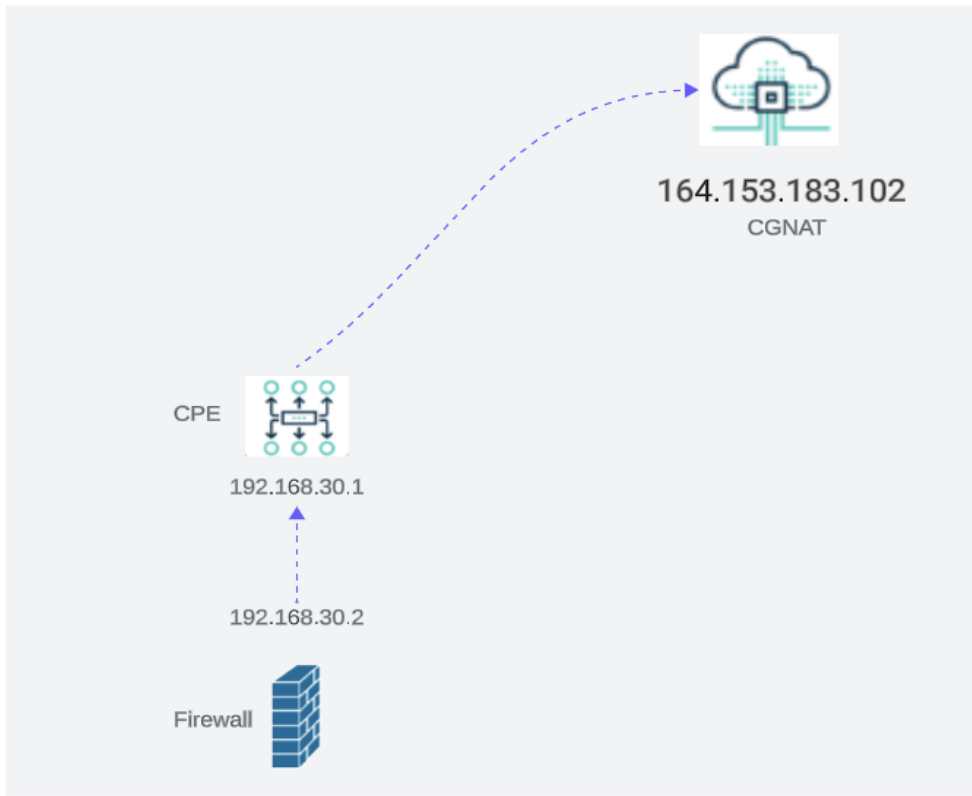
Customers with private IP address configuration benefit with the key features of this configuration. Some of the important features include a private IP address for LAN side devices, site-to-site connectivity with private IP addresses, and use of any gateway for internet traffic (CGNAT). This configuration also applies to My Connect that provides remote access to office networks. However, it must be considered that the private IP addresses are not directly routable from the internet. For using another private IP in the same subnet of the CPE LAN, NAT masquerading or PAT by the firewall is required.
In the table below are some sample use cases and benefits of a private IP configurations.
| Use Case | Explanation |
|---|---|
| Office Network | A mid-sized company's internal network uses private IP addresses (e.g., 192.168.x.x) for all employee devices. The office router uses CGNAT to translate these private IPs to a shared public IP for internet access. Employees connect remotely via My Connect, ensuring secure and seamless remote access to internal resources without exposing devices directly to the internet. |
| Call Center | A call center employs hundreds of VoIP phones connected through a private IP addressing scheme (e.g., 192.168.x.x). The office router uses CGNAT to translate these private IPs for external internet access. Internal communication is secure and efficient, with calls routed through an on-premise PBX system. For remote access and telecommuting, agents use My Connect to securely connect to the call center's network. This setup ensures cost-effective management while maintaining high security for internal communications. |
TERMS OF USE | ANTI SPAM | PRIVACY POLICY | USER LICENSE AGREEMENT | PATENTS