High Availability (HA)
Overview
High Availability (HA) refers to a system or network’s ability to remain continuously operational and accessible, ensuring maximum uptime while minimizing downtime.
The High Availability feature is a solution provided by Adaptiv Networks to eliminate a single hardware point of failure at the customer premises.
For Adaptiv Connect, High Availability (HA) specifically means:
- Two Adaptiv | Edge devices deployed with identical configurations
- Deployment alongside external WAN and LAN switches to provide full path redundancy
- Automatic failover if one device becomes unavailable
In this solution, two Adaptiv | Edge devices and multiple network switches are configured and deployed at the customer site. Under normal operation, one device actively routes traffic to and from the Internet while the other remains in standby mode. If one Edge device fails (due to hardware failure, power loss, or other issues), the secondary device automatically takes over routing data traffic to and from the Internet.
This architecture protects against network service outages and disruption caused by hardware, power, or certain network failures, ensuring continuous and reliable service delivery.
How High Availability Works
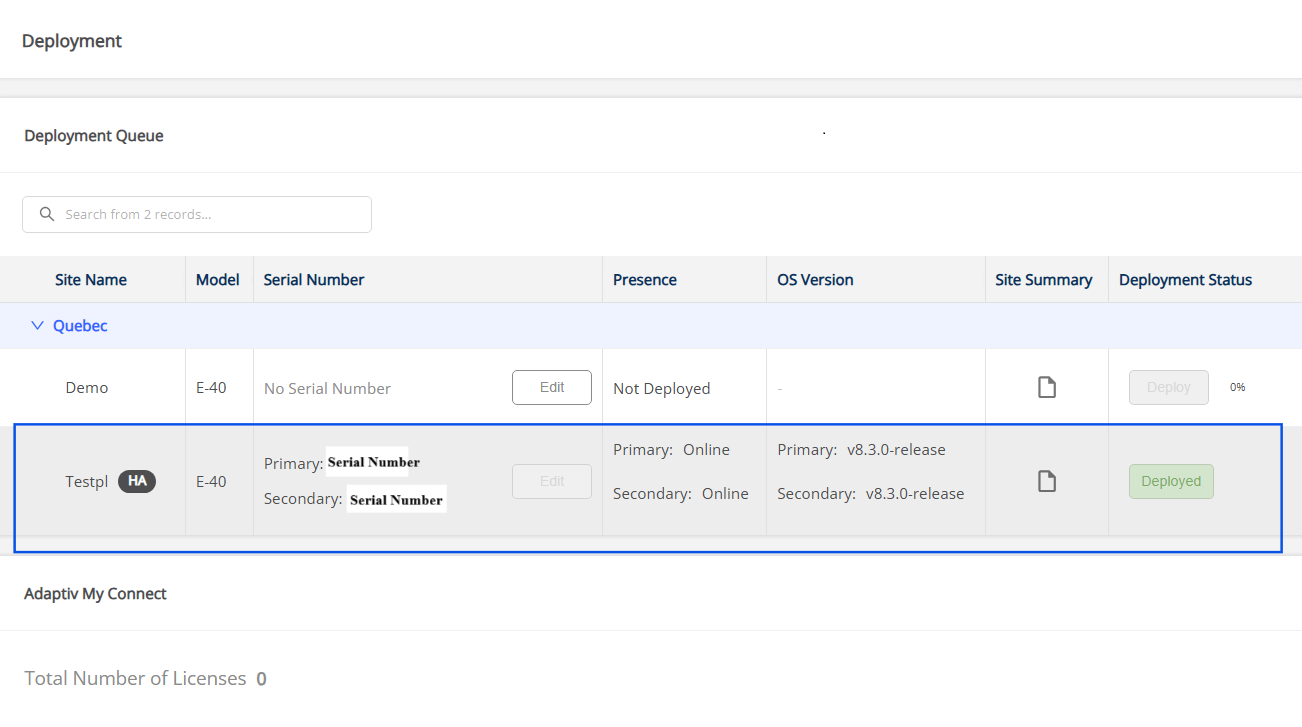
In Adaptiv Cloud Orchestrator, each HA-enabled site has two Edge devices— referred to as the primary and secondary devices—that are deployed and configured on the customer sites:
-
The primary device: Actively carries and forwards all network traffic during normal operation.
-
The secondary device: Remains in standby mode, ready to take over traffic whenever needed.
If the primary device experiences a failure, traffic automatically fails over to the secondary device, maintaining service continuity and avoiding interruption to critical applications.
When the primary device comes back online, the traffic will automatically be restored to the primary.

|
High Availability (HA) is designed to minimize the impact of hardware or electrical failure. However, the best way to avoid outages is to follow operating environment best practices. Hardware Environment & Power Protection Install hardware in a ventilated room below 24 °C (75.2 °F) with at least 6 inches clearance on all sides, including the top. Keep cables slack and ensure easy access for troubleshooting. Protect against power surges by using surge protection, and in locations with 10+ blackouts per year, connect to a UPS with at least 20 minutes of runtime.
|
Implementation with External Switches
High Availability relies on VRRP (Virtual Router Redundancy Protocol) implemented using keepalived.
Configuration Behaviour
- The configuration is automatically generated whenever the CPE's configuration changes.
The generated config is located at /etc/keepalived/keepalived.conf - A VRRP instance is created for each configured LAN port (i.e., subnet)
- The preferred master is given priority 101.
- The preferred backup is given priority 100
- A virtual IP address is associated with the LAN port. It will be automatically applied to the LAN port when the unit becomes master.
- All underlay ports are configured as "track_interface" with a weight of 2. This means that if a carrier is detected on the port, VRRP priority is increased by 2.
- There is also a weight of 2 associated with internet connectivity. keepalived would periodically (once a second) send a single ping packet to 8.8.8.8. If a response is received, VRRP priority is increased by 2.
System Behaviour - Failover Scenarios
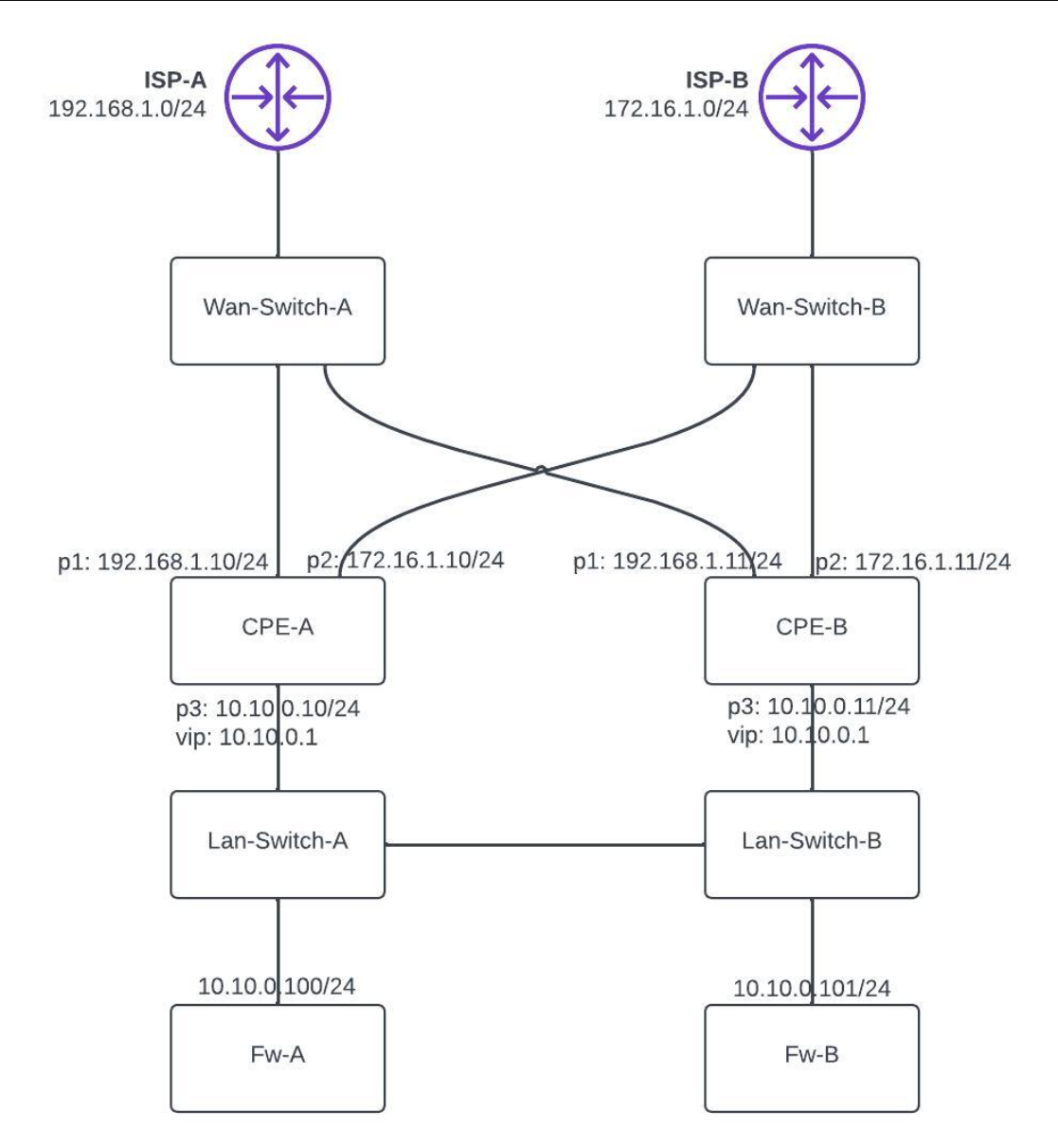
Assuming CPE-A is the preferred Master, expected behaviour for various events:
| # | Event | Expected Behaviour | Active Unit |
|---|---|---|---|
| 1 | ISP-A modem experiences a power outage | CPE-A will detect a network outage on ISP-A and fallback on ISP-B | CPE-A |
| 2 | ISP-A is unplugged from Wan-Switch-A | CPE-A will detect a network outage on ISP-A and fallback on ISP-B | CPE-A |
| 3 | Wan-Switch-A experiences a power outage | CPE-A will detect a network outage on ISP-A and fallback on ISP-B | CPE-A |
| 4 | CPE-A is unplugged from Wan-Switch-A | CPE-B becomes active | CPE-B |
| 5 | CPE-A is unplugged from Wan-Switch-B | CPE-B becomes active | CPE-B |
| 6 | CPE-A experiences a power outage | CPE-B becomes active | CPE-B |
| 7 | Lan-Switch-A experiences a power outage | CPE-A enters into fault, and CPE-B becomes active | CPE-B |
| 8 | ISP-B modem experiences a power outage | CPE-A will detect a network outage on ISP-B and fallback on ISP-A | CPE-A |
| 9 | Wan-Switch-B experiences a power outage | CPE-A will detect a network outage on ISP-B and fallback on ISP-A | CPE-A |
| 10 | CPE-B experiences a power outage | CPE-A remains active and is unaffected | CPE-A |
| 11 | Lan-Switch-B experiences a power outage | CPE-B enters into fault. CPE-A remains active and is unaffected | CPE-A |
Benefits of High Availability
Implementing High Availability (HA) with Adaptiv provides several key advantages for maintaining continuous and reliable network service:
- Increase Service Uptime — Maintains network connectivity even if one Edge device fails → minimizing disruption to business operations.
- Redundancy — Eliminates single points of hardware failure. Two devices share the workload, so the network doesn’t rely on a single unit. If one fails, the other keeps services running.
- Reliable Performance — Protects critical applications from outages or device failures.
TERMS OF USE | ANTI SPAM | PRIVACY POLICY | USER LICENSE AGREEMENT | PATENTS