Bi-Directional QoS
Bi-Directional QoS with Adaptiv Connect includes the following features:
- Inbound and Outbound Protection
- Priority Queue
- Real-Time Services Protection
- Dynamic QoS (No Reserved Bandwidth)
- UCaaS Prioritization
Inbound and Outbound Protection
Bi-Directional Quality of Service ensures that the traffic prioritization in both directions:
- Outbound QoS — is managed by the CPE.
- Inbound QoS — is managed by the Adaptiv Gateway.
Why is Outbound QoS managed by the CPE?
Outbound traffic is the traffic coming from the customer site (CPE) to the public network (Internet).
Therefore, the CPE is the first device able to classify and control it → The CPE can prioritize real-time applications and de-prioritize bulk traffic before it enters the public network.
Example:
A user uploading a large file → the CPE can limit its impact to ensure critical applications maintain performance.
Why is Inbound QoS managed by the Adaptiv Gateway?
Inbound traffic is the traffic coming from the public network (Internet) to the customer site (CPE).
Normally, when inbound congestion occurs, it happens before the traffic reaches the CPE. Once the traffic reaches the CPE, it's too late to apply QoS.
For this reason, QoS is applied at the Adaptiv Gateway when it first enters the Adaptiv infrastructure, prioritizing critical applications and de-prioritizing lower-priority traffic before sending it to the customer site.
Example :
A video conference is in progress. At the same time, users are downloading large backup files, which begin to consume bandwidth from other users.
→ The Adaptiv Gateway limits the bandwidth consumption of the lower-priority (large downloads) so the quality of experience for users taking part in the video conference remains smooth and uninterrupted.
Key Principle: Bi-Directional QoS should be applied at the point where congestion can be managed/controlled before traffic continues on its journey.
Priority Queue
The priority queue ensures that critical applications still receive the bandwidth they need during network congestion events.
Applications can be assigned priority levels either by using policy templates or priority can be assigned by application category based on specific customer needs. Priority ranking goes from P1 (highest priority) to P5 (lowest priority).
Traffic is then processed in order of priority:
- Higher-priority applications are sent first.
- Lower-priority traffic may be temporarily delayed when the network is busy. To preserve overall network performance and responsiveness, essential traffic is prioritized, and if the queue for lower-priority traffic becomes full, those packets are dropped rather than delayed.
→ This ensures that essential services remain uninterrupted and maintain optimal performance, even during periods of congestion.
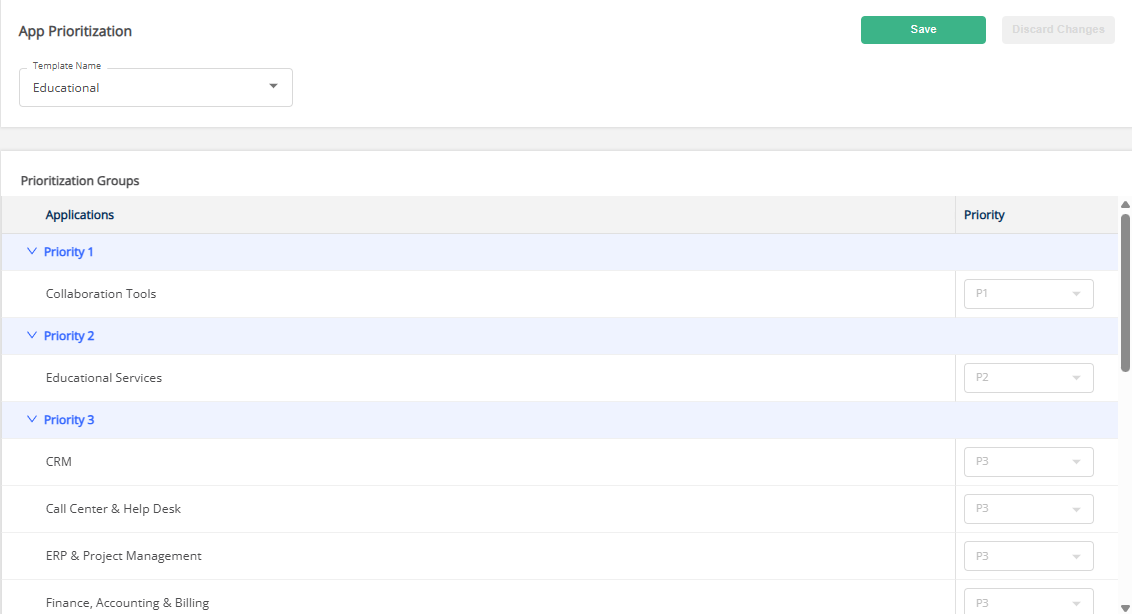
Example: Educational App Prioritization template.
In the App Prioritization template shown below, collaboration tools are assigned the highest priority (P1), followed by educational services (P2). Services such as finance or billing, which are not sensitive to latency or jitter, are placed at a lower priority (P3). This approach ensures that essential applications maintain optimal performance during periods of network congestion.
Real-Time Services Protection
Bi-Directional QoS insulates real-time applications such as voice and video conferencing from performance breakdown caused by overloaded or saturated ISP links. By prioritizing real-time services, Adaptiv ensures live calls and meetings remain clear and uninterrupted, even when other traffic is consuming bandwidth.
Example:
During a large Cloud storage synchronization operation, QoS reduces the impact of network congestion on ongoing voice or Microsoft Teams calls by ensuring they are handled through a higher-priority queue.

|
When real-time services (e.g., Teams or Zoom calls) occur simultaneously with other prioritized applications (e.g., video gaming for a gaming production company), Bi-Directional QoS gives higher priority to real-time services such as voice and video. |
Dynamic QoS (No Reserved Bandwidth)
Unlike traditional static QoS, which allocates fixed bandwidth to specific applications, Dynamic QoS allocates bandwidth on demand and adjusts in real-time based on network conditions. In a static QoS scenario, for example, if 20% of the bandwidth is reserved for voice, that bandwidth becomes unusable at any time for other types of traffic.
→This ensures that critical applications always receive the resources they need, even when traffic conditions change, provided that their combined throughput does not exceed the available bandwidth. Conversely, when no real-time services or high-priority apps (e.g., voice or video calls) are active, lower-priority traffic can take advantage of the unused bandwidth.
Example:
If multiple users start streaming video simultaneously, the system dynamically adjusts bandwidth allocation so high-priority applications like VoIP or UCaaS continue to perform smoothly, without wasting bandwidth on unused reserved allocations (for lower-priority traffic).
UCaaS Prioritization
Unified Communications as a Service (UCaaS) applications and services (i.e. integrated Cloud-delivered communication and collaboration tools) are particularly sensitive to network congestion and are usually the first to experience instability and breakdown. With Adaptiv, Bi-Directional QoS puts UCaaS as a top priority, allowing it to take the full available bandwidth when required, maintaining high-quality voice and video sessions.
Example:
During peak usage, when multiple users are on video calls while large file transfers are in progress, UCaaS traffic is prioritized to keep meetings clear and uninterrupted. File transfers are slowed or queued to ensure real-time communication remains smooth and reliable.
For more practical examples of how Bi-Directional QoS is a beneficial feature for businesses, you can click on the link: Bi-Directional QoS Business Use Cases.
TERMS OF USE | ANTI SPAM | PRIVACY POLICY | USER LICENSE AGREEMENT | PATENTS