Understanding the SC//Reliant™ platform
The Scale Computing Reliant platform is an enterprise-grade edge computing, security, and compliance management solution designed for retail, hospitality, quick service restaurants, and other multi-site businesses. It provides centralized control over network security, application orchestration, and regulatory compliance while ensuring the high availability of mission-critical systems.
A single platform consolidates the work that previously required separate point-of-sale (POS) servers, network appliances, security gateways, IoT gateways, signage controllers, and back-office VMs, operating them under a unified control plane that scales to multi-thousand-site fleets. Core capabilities include configuration management, orchestration at scale, application delivery for both new and legacy workloads, centralized monitoring and data collection, and operational reliability during WAN outages and hardware faults.
The SC//Reliant platform follows a hybrid cloud-edge architecture, combining centralized management with localized computing at the network edge. The diagram below illustrates the high-level architecture of a typical two-node edge compute cluster.
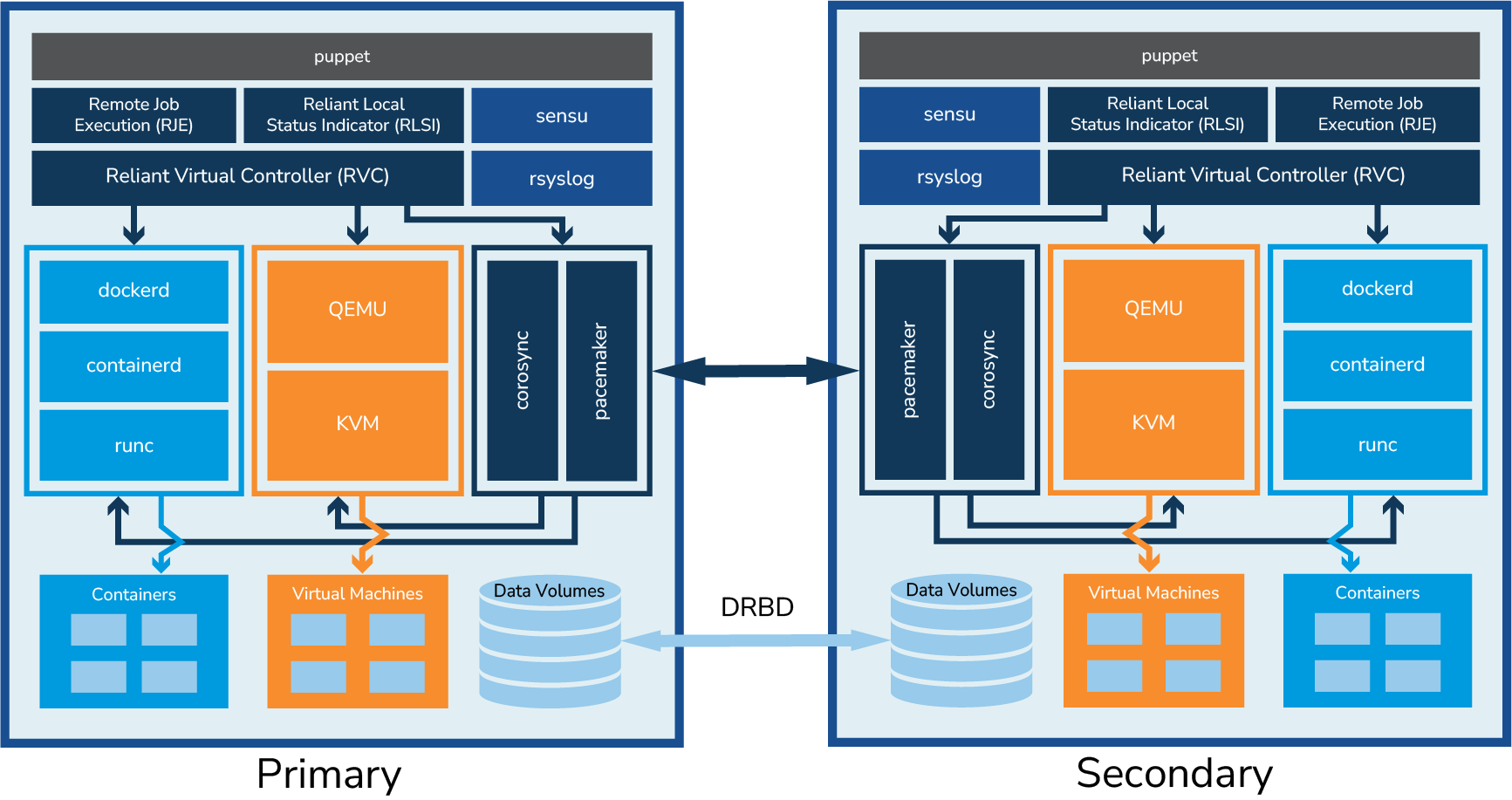
Primary components
The SC//Reliant platform consists of three primary components:
- SC//Reliant Platform Manager – A multi-tenant web application backed by an API that provides configuration, orchestration, and management of the SC//Reliant platform.
- SC//Reliant Management Plane – A dedicated, single-tenant server environment for management, monitoring, central log collection, and analysis. The deployment model is flexible and cloud-agnostic: it can be hosted by Scale Computing as a managed service, in the operator's own on-premises data center, or in the operator's preferred public-cloud account (for example, AWS, Azure, or Google Cloud). The platform is not tied to any single cloud provider, and operators may choose the model that best fits their data-residency, sovereignty, and operational requirements.
- SC//Reliant Edge Platform Compute Nodes (on-premises) – Deployed at site locations or other distributed environments, these nodes deliver and manage applications and systems while providing local high availability.
Architectural principles
The SC//Reliant platform is built on the following architectural principles:
- Hardware-agnostic
- Cloud-agnostic
- Application-agnostic
- DevOps-native
- Centralized orchestration with local autonomy
- PCI components built in (firewall, Intrusion Detection System (IDS), File Integrity Monitoring (FIM), vulnerability scanning, logging)
Platform mental model
The SC//Reliant platform is organized in three layers.
The edge appliance, what runs at the site
Each site is served by one or more on-site edge appliances running Debian Linux with integrated networking, security, virtualization, and orchestration. The appliance hosts workloads as containers, virtual machines, or both simultaneously on the same hardware. Multi-tenancy is built in: POS, payments, IoT, back-office, signage, and guest Wi-Fi run side-by-side with strong isolation between them.
The control plane, the brain that operates the fleet
The SC//Reliant Platform Manager is the web-based central console used to configure, deploy, monitor, and patch the entire estate. Behind it, a Puppet-based infrastructure-as-code engine continuously enforces the desired state of every node, and SC//AcuVigil™ delivers managed network services with PCI-compliant remote access. The control plane is cloud-agnostic: it can run as a managed SaaS from Scale Computing, in a public cloud (AWS, Azure, or Google Cloud are common choices), or in an operator-managed private cloud or on-premises data center. The specific destination is an operator choice, the platform is not built around any one hyperscaler.
The orchestration model, how the platform stays consistent at scale
A single site image is built once, then customized through templates with overrides at enterprise, group, or individual-site level. Deployments target a specific site, a region, a group, or the entire fleet, and the platform converges on the desired state, typically within minutes with health gates and automatic rollback if anything goes wrong.
Cluster terminology: inside vs. outside the cluster
When referring to virtual nodes as inside or outside the cluster, the distinction is whether or not the clustering software is monitoring the virtual node to determine whether a failover is needed. If a virtual node is inside the cluster, the cluster fails over if there is an issue providing that virtual node. Issues affecting a virtual node that is outside the cluster do not trigger a failover.
Going deeper
- See Platform Architecture for the deeper architectural discussion: hypervisor and runtime, orchestration engine, cloud control plane, open standards posture, multi-tenancy, hardware-agnostic deployment, data residency, multi-group and multi-brand support, MACH alignment, and deployment models.
- See the Platform Components child pages for descriptions of each component that makes up a SC//Reliant platform node: